How to Get Your Brand Recommended by ChatGPT
Your competitor keeps showing up when buyers ask ChatGPT for a pick, and you don't. The fix is mostly off your website, and it starts with what other people say about you.

You can't write your way into ChatGPT's recommendations from your own website. Other people have to do most of the talking.
Here's how to get your brand recommended by ChatGPT: make sure its search crawler can read your site, describe your brand the same way everywhere, then earn specific, consistent mentions on the places ChatGPT actually reads, which means reviews, Reddit threads, YouTube videos, press and "best of" comparison articles. OpenAI says ChatGPT picks products using structured data, third-party content, what the model already knows and the shopper's own context. You can't pay for the answer. You earn it off-site, one honest mention at a time.
I'll be honest about why this post exists. Lately founders bring me the same screenshot. "I asked ChatGPT for the best one in my category and it named my competitor three times. Me, zero."
The instinct is to rewrite the homepage. Wrong door.
How does ChatGPT choose which brands to recommend?
OpenAI spells it out on its Shopping with ChatGPT Search help page, updated this week. When ChatGPT decides what to surface, it considers:
- Structured metadata from first-party and third-party providers (price, product description) plus "other third-party content."
- What the model already says before it runs any new search.
- OpenAI's safety standards and product policies.
Then your buyer's context bends the weights. Mention a $30 budget and price matters most. Skip the budget and it may lean on reviews and ease of use.
Look at how much of that list you don't own. Even the "Budget-friendly" labels on product cards come from information that "may include third party data," and the review summaries come from reviews "from public websites."
ChatGPT doesn't take your word for it. It takes everybody else's.
And product results "are not ads, nor influenced by any OpenAI partnerships." No bid. If you want ChatGPT to say your name, a lot of other people have to say it first.
Why do off-site mentions beat your own website?
Because the data says so, as close as anyone can measure it right now.
In December 2025, Ahrefs ran a correlation study across 75,000 brands and their mentions in ChatGPT, Google AI Mode and AI Overviews. Here's what lined up with being mentioned, and what didn't:
| Signal | Correlation with AI mentions | What it tells you |
|---|---|---|
| YouTube mentions (all three platforms) | about 0.737 | Videos about you were the strongest signal |
| Branded web mentions | 0.66 to 0.71 | People naming you across the web matters a lot |
| Branded search volume (ChatGPT) | 0.352 | Being searched for helps, but less |
| Domain Rating (ChatGPT) | 0.266 | Classic site authority is weak here |
| Number of pages on your site | about 0.194 | Publishing more pages barely moves it |
Ahrefs is careful to say correlation isn't causation. Fair. But look at the bottom row. The thing most founders reach for first, more content on their own site, has almost no relationship with being mentioned.
So if you were planning to publish 40 new blog posts to get into ChatGPT, hold that thought. (Yes, I see the irony of saying that in a blog post.) A post on your site is you talking. A Reddit thread is a witness.
Which sites does ChatGPT actually read?
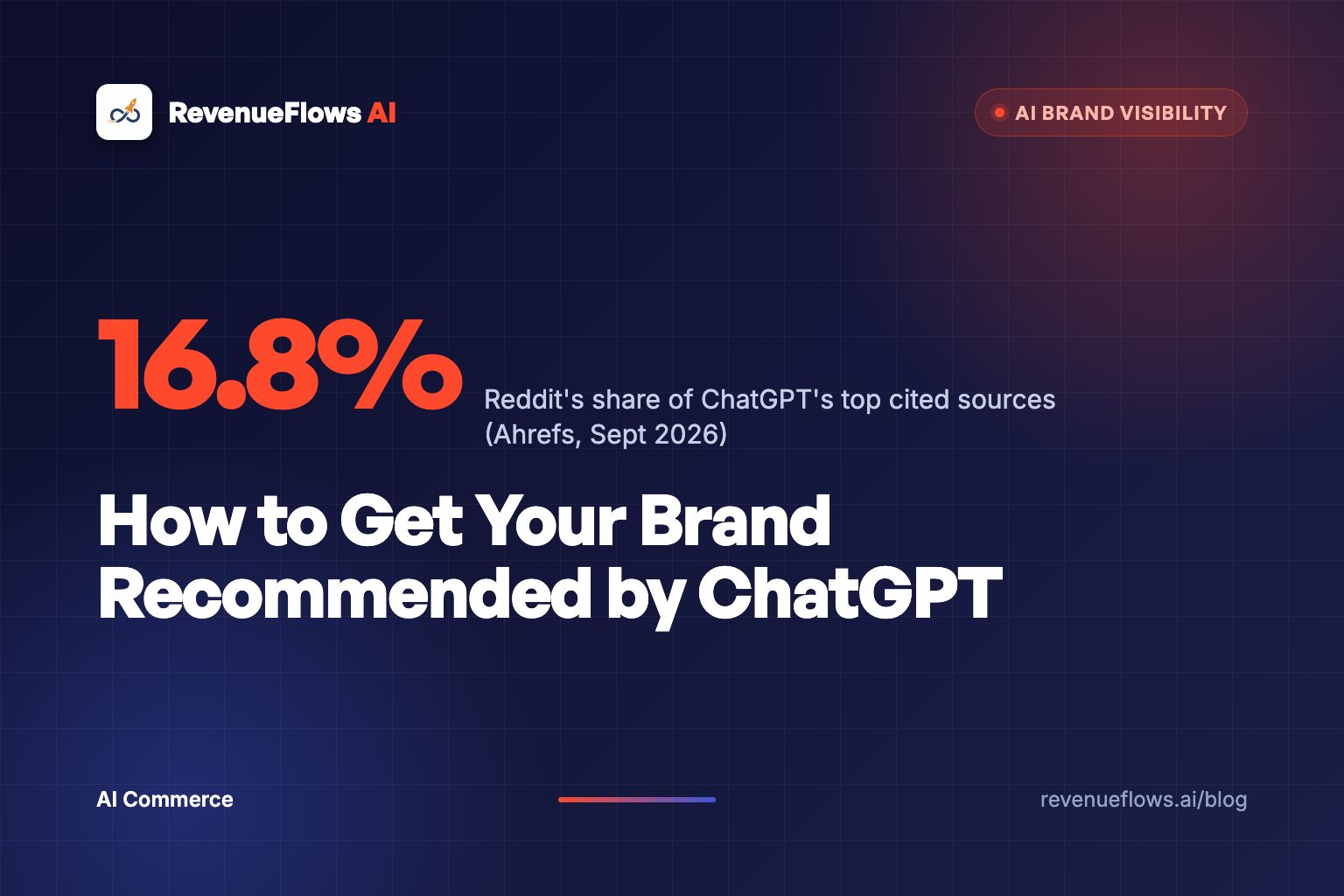
Ahrefs' most cited domains in ChatGPT report, updated September 2026, puts Reddit first at 16.8% of top-source mentions. Wikipedia is second at 7.0%. Consumer Reports is third at 3.7%, then Forbes, with YouTube and Walmart also in the top 10.
People arguing, reviewing and comparing. Not brand homepages.
Now the curveball. A Mode Marketing study replayed 53 questions to OpenAI, Claude and Perplexity over 17 days in July 2026. The three engines cited 1,378 different domains between them, and 84.6% of those domains were cited by exactly one engine. Only 26 were cited by all three.
Here's the thing. There's no single magic site. ChatGPT's sources for "best linen sheets for hot sleepers" won't match its sources for "best weighted blanket for kids." Find the pages ChatGPT cites for your buyer's questions, then earn a place on those.
There's no master list. There's your category's list, and you have to go read it.
What makes a mention count for your brand?
Not every mention is equal. A mention ChatGPT can use has three things.
It's specific. "Love this brand!" gives the model nothing to repeat. "Kept my toddler cool through a 92 degree July night, washed 30 times and still soft" gives it a sentence it can summarize, and a use case it can match to a buyer's question.
It's consistent. If your Amazon listing calls you "premium bamboo bedding," your Instagram bio says "sustainable sleep essentials" and a gift guide calls you "affordable sheets," the model sees three half-brands. Pick the one phrase you want to be known for (the buyer, the problem, the proof) and say it the same way on your site, your profiles, your press kit and every pitch you send.
It's independent. Reviews from real buyers. Forum replies from people who own the thing. A roundup where the writer tested you against two competitors. Planted praise reads like planted praise, to people and to machines.
This is where most brands are skinny. They've got 400 reviews on their own product page and almost nothing about them anywhere else. To ChatGPT, that's a store talking to itself.
How do you find out why your competitor gets named?
Run the check before you start the work. It takes one afternoon.
- Write 15 questions in your buyer's words. "Best cooling pillow for side sleepers under $80," not "cooling pillow."
- Ask each one in ChatGPT and log every brand it names.
- Click the sources it cites. Note the Reddit threads, roundups and review sites behind your competitor's mentions.
- Search those pages for your brand. Zero mentions is your to-do list.
- Repeat monthly, same 15 questions, so you're tracking a trend and not a mood.
If you want a faster first read before you build the spreadsheet:
Also check one technical thing today. OpenAI's crawler documentation says sites that opt out of OAI-SearchBot won't be shown in ChatGPT search answers, and changes take about 24 hours to kick in. GPTBot is separate and covers model training. OpenAI's shopping research help page adds that when retailers block automated access, shopping research will skip those sources or rely on other sites with similar products. Read that as: block the bot and ChatGPT sells your competitor's version instead.
And skip the shortcut files. Our llms.txt Shopify breakdown explains why one doesn't replace any of this.
What should you do on Reddit, YouTube and press?
Go where the witnesses are. Each channel wants something different.
Reddit. Find the threads ChatGPT already cites for your category and answer the question honestly, with your name and your affiliation stated. Recommend a competitor when they're the better fit. That's what earns trust in those communities, and trust is what gets upvoted and quoted. If Reddit does send traffic, the buyer lands skeptical, so read how to write a Shopify product page for Reddit traffic before you post anything.
YouTube. The strongest signal in Ahrefs' data. Send product to reviewers who make honest comparison videos in your niche. No script. No approval rights.
Reviews. Ask buyers for reviews that name their use case. Our research on whether product reviews increase Shopify conversion rate shows why specific beats plentiful.
Press and comparison articles. Pitch the writers behind the "best of" roundups ChatGPT cites, with a sample and one sentence on who your product is best for.
Your own feed. If you're on Shopify, OpenAI's merchant page says your catalog is already integrated, no application needed, and shopping is live for U.S. users. Getting single products to the top of the carousel is its own job, covered in how to rank products in ChatGPT.
What happens when ChatGPT finally names you?
The buyer clicks. And lands on your page.
OpenAI says on its merchant page it's "moving away from a standalone Instant Checkout experience," and purchases are completed on merchant-owned websites or apps. Its March post, Powering Product Discovery in ChatGPT, says the shift brings merchants "higher-intent shoppers who are closer to making a decision." We covered the backstory in what happened to ChatGPT Instant Checkout.
So all that off-site work ends on your product page, and that page decides what every recommendation is worth.
Here's the math. Run it on a store like this, a hypothetical: a linen pillowcase brand getting 1,500 visitors a month from ChatGPT. On a standard page, conversion rate is 1.2% and average order value is $68. That's $0.82 revenue per visitor, or $1,224 a month. Rebuild the page so the first screen repeats what ChatGPT just told the buyer, and say conversion rate reaches 2.6% with a $79 average order value from a two-pack offer. That's $2.05 revenue per visitor, or $3,081 on the same 1,500 visitors.
Conversion rate x average order value x visitors. A hypothetical store, not a client result.
Same recommendation. $1,857 more a month.
We've seen what a rebuild does on pages we've worked on. On a bedding brand's Cooling Bamboo Sheets, conversion rate went from 1.0% to 4.3%, and revenue per visitor after the rebuild hit $10.92. See the full case study numbers. Real client numbers, not typical results, and not a promise of what your store will do.
A recommendation is a borrowed reputation. Your page has to pay it back.
Bleeding pages turn a hard-won mention into a bounce. Printing pages turn it into an order. Judge every AI channel by revenue per visitor, and write the page for the pre-sold buyer the way we laid out in how to write a Shopify product page for ChatGPT traffic. The full channel map lives in our AI commerce guide.
Frequently asked questions
How does ChatGPT choose which brands to recommend? Structured product data, third-party content like reviews, what the model already knows and the shopper's context. Consistent, specific off-site mentions get you named more often.
Can I pay to get my brand recommended by ChatGPT? No. OpenAI says product results aren't ads. Ads are a separate, labeled unit.
Does Reddit really affect ChatGPT recommendations? It shows up a lot. Ahrefs found Reddit was the most cited domain in ChatGPT at 16.8% of top-source mentions, ahead of Wikipedia at 7.0%.
How long does it take to show up in ChatGPT answers? Crawler fixes take about 24 hours, per OpenAI. Earning reviews, threads and roundup placements takes months, so give it a 90-day run before you judge.
Why does ChatGPT recommend my competitor and not me? Usually because more independent sources describe them in the buyer's words, consistently. Check the sources ChatGPT cites and earn a fair mention on those exact pages.
What to do next
Tonight, ask ChatGPT the one question your best customer would type before buying from you. Click every source it cites. Count how many mention you.
That number is your starting line. Write it down, then pick the first thread to answer tomorrow.
Book Your Profit Audit
Getting ChatGPT to name you is slow, honest work, and it only pays off if the page it sends buyers to can close them. Get your free profit audit and we'll show you where that page is leaking pre-sold buyers, then show you how to rebuild a high-converting product sales page in less than 15 minutes.
Or go here to check it out → revenueflows.ai
P.S. Your website is your testimony. Reddit, reviews and roundups are your witnesses. ChatGPT believes the witnesses, so go earn them, then give the buyer a page worth landing on.
Frequently asked questions
How does ChatGPT choose which brands to recommend?
OpenAI says ChatGPT weighs structured product data from first-party and third-party providers, other third-party content like reviews, what the model already knows, and the shopper's own context. In practice that means brands with consistent, specific mentions across reviews, forums, press and comparison articles get named more often.
Can I pay to get my brand recommended by ChatGPT?
No. OpenAI says product results are selected independently and aren't ads or influenced by partnerships. Ads in ChatGPT are a separate, labeled unit, so you can buy a slot near the answer but not the answer itself.
Does Reddit really affect ChatGPT recommendations?
It shows up a lot. Ahrefs' September 2026 analysis found Reddit was the most cited domain in ChatGPT at 16.8% of top-source mentions, ahead of Wikipedia at 7.0%. Correlation isn't proof of cause, but honest Reddit threads in your category are clearly part of what ChatGPT reads.
How long does it take to show up in ChatGPT answers?
Crawler changes can take effect in about 24 hours, according to OpenAI. Earning reviews, forum mentions and roundup placements takes months, so plan on a 90-day run of consistent off-site work before you judge the results.
Why does ChatGPT recommend my competitor and not me?
Usually because more independent sources describe your competitor in the words buyers use, and they say it consistently. Check which sites ChatGPT cites in its answer, then work to earn a fair mention on those exact pages.